October 2026
Kitchen walls get painted less often than any other room in the house, and they need it more. The cabinets take up most of the wall, the backsplash takes the rest, and what is left looks too small to bother with. Then you notice the ceiling over the stove has gone a shade darker than the ceiling in the hall, and the paint by the light switch has a shine that was not there before.
Painting a kitchen is mostly prep, more than any other room. This post covers the walls and the ceiling only, with the cabinets left exactly as they are, and what it takes to get paint to stay put in the busiest room of a Corona home.
Grease You Cannot See Until the Paint Will Not Stick
Cooking puts a thin film of grease into the air every day, and it settles on every surface in the room, walls and ceiling included. You cannot see it on a light wall. You can feel it: run a finger across the wall above the stove or beside the fridge and it comes away slightly tacky.
Paint does not bond to grease. Roll fresh paint over that film and it can look perfect for a week, then start peeling in sheets near the range, or show small craters where it pulled away from the oily spots. A better can of paint does not fix that. Cleaning does: every surface getting painted is washed with a degreaser, rinsed, and left to dry, top to bottom.
On a kitchen that has gone a long time between paint jobs, we also look for old patches of glossy paint and touch-up spots that never quite matched. Glossy surfaces get deglossed or scuffed so the new coat has something to grip. Nail holes, cracks in the corners and dings from chair backs get filled and sanded, and any water or smoke stain gets sealed with the right primer before color goes on.
None of that shows when the job is done. It is the part that decides whether the paint is still on the wall a few years from now, and it is the part a rushed crew skips because nobody can tell the difference on the day they get paid.
A Tougher Sheen Than the Living Room Gets
Paint in a living room mostly gets looked at. Kitchen paint gets wiped. Splashes from the sink, fingerprints by the switches, sauce on the wall behind the stove, and a damp rag after every one. A flat finish that looks soft and rich in a bedroom will not hold up to that. It burnishes, going shiny where it gets rubbed, and stains soak in instead of wiping off.
So kitchen walls usually get a finish with more sheen than the rooms around them: eggshell, satin or semi-gloss, depending on how hard the room works and how much of the wall texture you want to see. More sheen wipes cleaner and stands up to scrubbing. The trade-off is that it shows every bump and patch in the wall, one more reason the prep cannot be skipped.
Where the kitchen opens into the family room, people worry the sheen change will show. Usually it does not, as long as the color stays the same and the change lands at a natural break: an inside corner, the edge of an arch, the end of a soffit. We point those breaks out on the walk-through so you can see where the line will fall.
Ceilings are the exception. Most kitchen ceilings look best in a flat finish, which hides roller marks and the uneven light from can lights. The one place we sometimes go tougher is a low ceiling right over a cooktop that gets steam every night.
The Line Along the Cabinets and the Backsplash
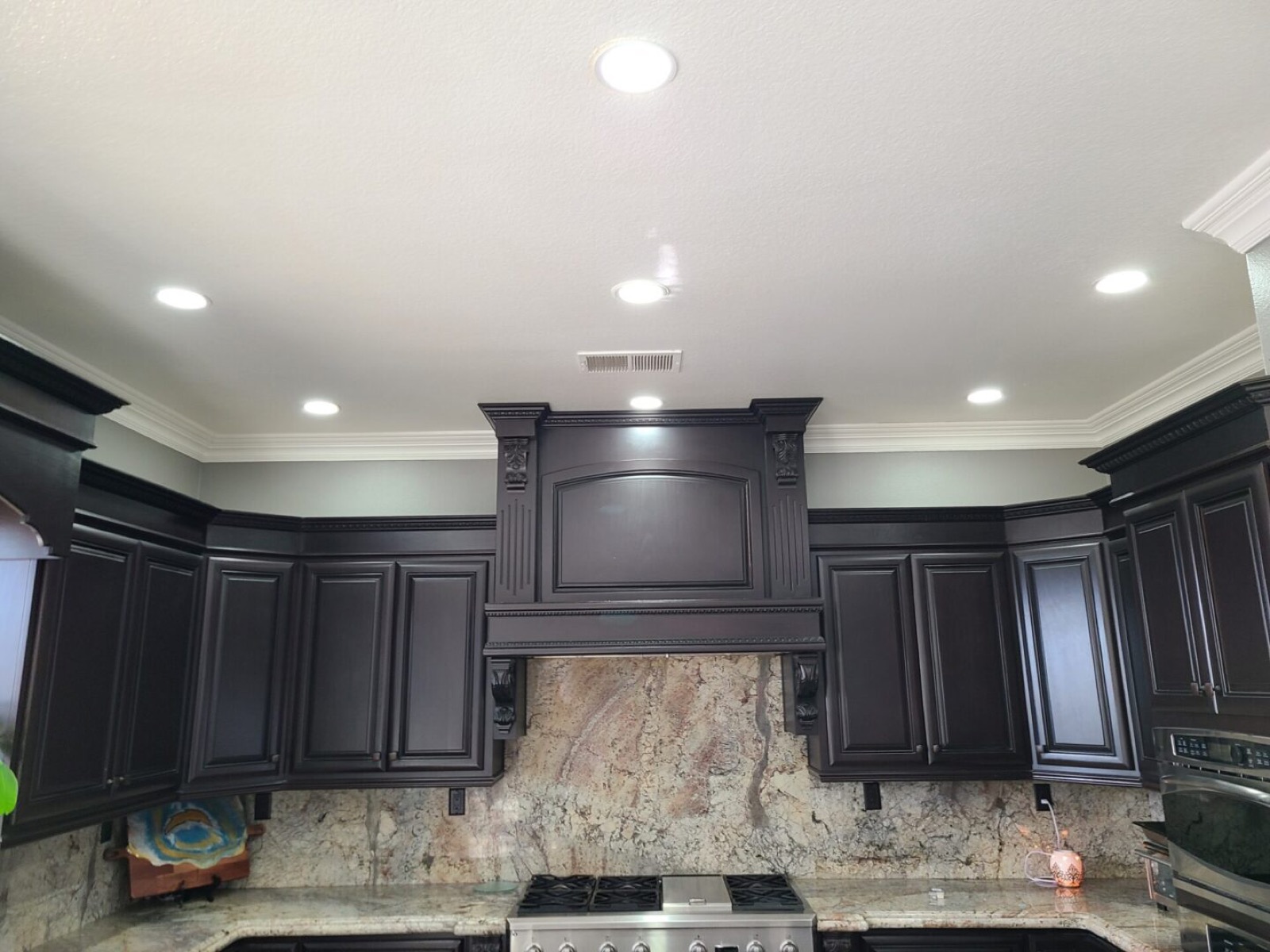
In a kitchen nearly every wall ends at something that is not getting painted. The tops of the upper cabinets, the sides of the cabinet boxes, the edge of the backsplash, the countertop, the window trim over the sink, the hood. Each of those is a cut line, and in a kitchen they sit at eye level where you look at them every morning with your coffee.
A clean cut line is done by hand with a brush, slowly, after everything around it is covered. Countertops get covered edge to edge, the cabinet faces get draped in lightweight plastic, and appliances get pulled out where they can be and covered where they cannot. Lights, outlets and switches are masked with the plates removed and put back once the paint is dry.
Where the wall meets a stone or tile backsplash, the edge of the old paint often carries a ragged caulk line or a ridge where several past coats built up. That gets cleaned up before the new line goes on, sometimes with fresh caulk in a color that suits the wall or the stone. The goal is a line that reads straight when you stand at the sink.
The strip above the upper cabinets deserves a mention. On a lot of kitchens there is a band of wall between the cabinet tops and the ceiling that nobody has painted carefully in years. It is awkward to reach, and it is the first thing you see from the family room couch.
Above the Range and Around the Can Lights
The wall and ceiling above the stove take more punishment than anywhere else in the house. Heat and steam rise straight up, and grease, smoke and the odd flare-up leave a yellow or brown stain on the ceiling that spreads out past the hood. Wash it and paint over it, and it often comes back through the new paint as a tan shadow.
That stain has to be sealed. After cleaning, the stained area gets a stain-blocking primer made for exactly this, and the primer dries fully before the finish coats go on. On a ceiling that means priming wider than the stain itself, so there is no outline of a patch when the light hits it.
The short stretch of wall between the hood and the upper cabinets on either side gets the same care. It is usually the greasiest painted surface in the house, and it is cramped, so it is easy to miss a corner. We clean it twice, prime anything that has yellowed, and cut it in by hand around the hood so the edge stays tight against the metal.
Recessed can lights cause their own problem. Heat from the bulb draws dust and kitchen grease up through the gap around the trim ring, and over the years each light grows a dark halo on the ceiling. Those rings get the same treatment, cleaned, primed and painted, and the trim rings come down while we work so the paint reaches right to the opening and none ends up on the trim.
Done this way, a white ceiling stays white instead of going beige over the stove a year later. Every coat gets the full amount of paint the can is rated for, which is what John built this company on, and on a ceiling a thin coat shows up as roller stripes the first time afternoon light comes across it. Kitchens like this are a big part of our interior house painting in Corona.
Get a Ballpark on the Kitchen
If the ceiling has gone tan over the stove or the walls feel tacky by the range, call (951) 685-1595 or send us a message. We come out on our Corona route, look at the walls and ceiling with you, and give you a ballpark at that visit. The cabinets can stay right where they are.