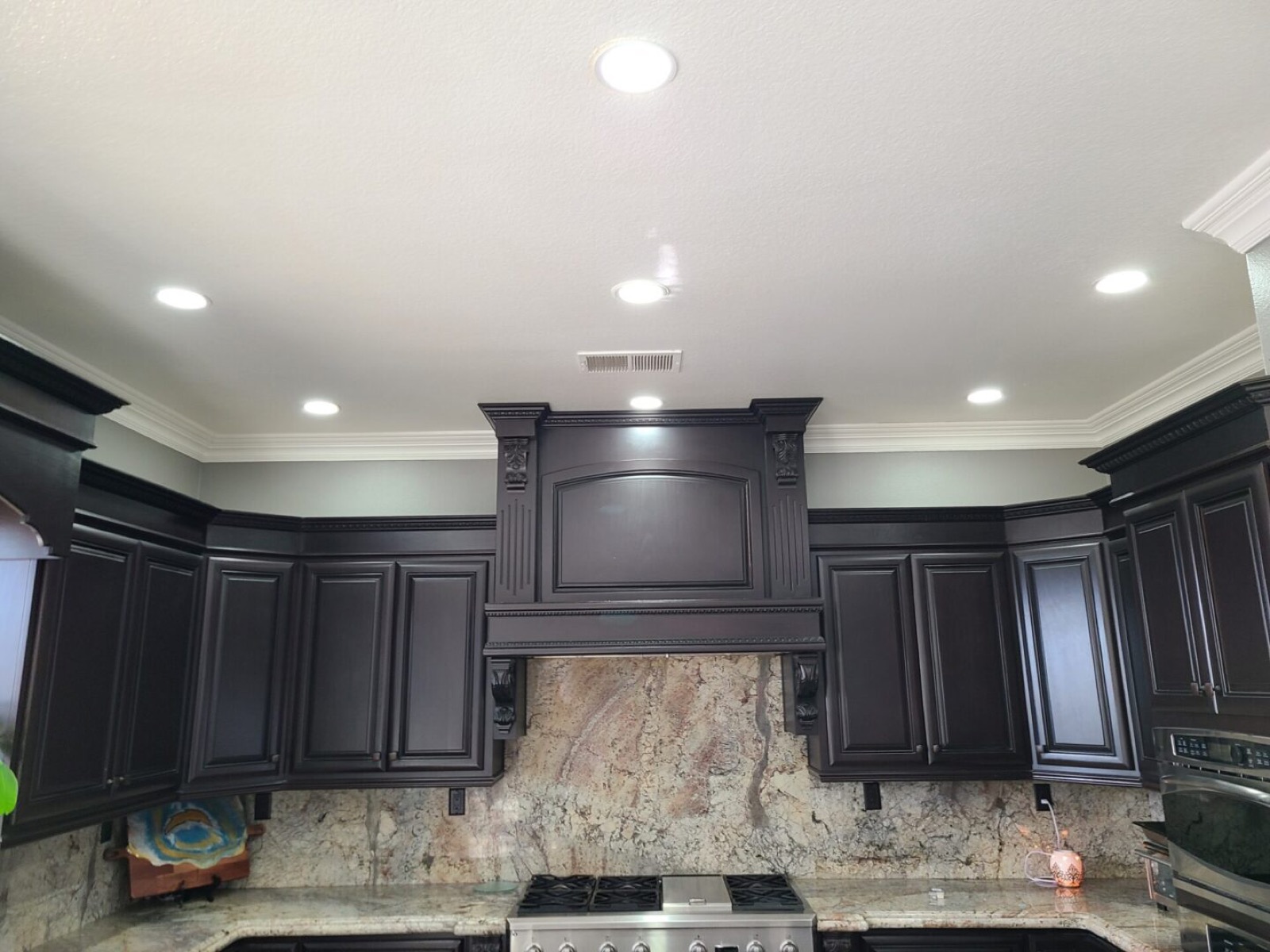
Cabinet Staining done at full strength
Stain is honesty about wood. We even out tone, match existing color where you are extending, and topcoat with conversion-grade clear that stands up to kitchens. Out of Jurupa Valley, across Riverside and San Bernardino Counties, quoted from measured footage and the spread rate on the can. See the finished work or ask for a ballpark.
☎ (951) 685-1595Inside the job, before the paint
Refinishing beats replacing more often than the showroom wants you to know. Good boxes with tired finishes are a craft opportunity, and the result reads new at a fraction of the cost.
Finishing is the patient end of painting. Where wall work is measured in rooms per day, cabinet and wood work is measured in surfaces per coat and hours per cure. We staff it with the crew members who like it slow and perfect, because that is who it takes.
Who calls for this: kitchens that function perfectly but look like their install date, owners quoted a remodel who want ninety percent of the effect for a fraction of it, and anyone whose wood doors have gone orange with age. If the boxes are sound, this is the smartest money in the house.
Our painters are employees who have been doing this a long time, so they move quickly and know how to work in a house that people are living in. Your comfort during the job matters to them as much as the finish.

From first call to final coat
Label and pull
Every door, drawer, and hinge is labeled and pulled. Hardware bagged. The kitchen stays usable while boxes are masked. The labeling map means every hinge returns to its born hole, which is why doors hang true after.
Clean and degloss
Grease is the enemy of adhesion. Everything is degreased, scuffed, and deglossed until the surface is ready to hold a finish for years. Degreasing gets tested with a water-break check, not assumed from effort.
Prime with a bonding system
Cabinet-grade bonding primer, sprayed and sanded. This is the coat that decides whether the finish chips at the first key scratch. Primer gets sanded to glass because the topcoat can only level what lies beneath it.
Spray the finish flat
Doors and drawers sprayed horizontal in controlled conditions for a level, factory-grade film. Boxes sprayed or brushed in place to match. Film thickness is measured in wet mils as we spray, the way the datasheet intends.
Cure, rehang, and dial
Finishes cure to handling hardness before reassembly. Doors rehung, gaps evened, soft-close checked, hardware back exactly where it lived. Cure days are protected days. The kitchen that waits three days keeps its finish thirty times longer.
Specs first, brands on request
Spraying is only as good as the booth conditions. We control dust, temperature, and film thickness on every door and drawer, then flat-stack them through cure. It is slower than propping doors against a fence, and it is why our finishes read factory.
The difference between a cabinet job that chips in a month and one that lasts a decade is the system: cleaner, bonding primer, and a hard-curing topcoat, each given its full dry window. We do not rush cures to hit a Friday, and your hardware goes back on only when the film can take it.
Built for this valley
The Inland Empire builds in generations: craftsman wood downtown, postwar stucco in the first rings, tract two-stories from the 80s and 90s, and new construction still pouring east. Each generation fails and revives differently, and we have repainted them all enough times to know their habits before the walk-through. Whatever era your property is, it is not our first one.
The same crews run the same routes year after year, which means the painter on your ladder has probably already painted on your street. Continuity is a quality tool.
Why the low bid is the expensive one
Cabinet shortcuts are brutal because hands find every one: finishes that chip at the knobs, doors that stick from fat edges, grain that telegraphs through skipped priming. Furniture-grade means the finish survives the family, not just the photos.
Redoing a failed cabinet job costs more than doing it right the first time, because the failed finish has to come OFF before anything new goes on. Stripping chipped enamel from forty doors is the most expensive way to learn what bonding primer was for.
Ask any bidder whether the job is priced on the amount of paint the manufacturer specifies for each surface. Our owner learned to ask after watching an employer use half of it. Send us the bid and we will go through it with you.
On the same visit
Since the ladders and drop cloths are already out, these often get done in the same trip:
- Kitchen Cabinet Painting
- Bathroom Cabinet Painting
- Built-In Cabinet Painting
- Cabinet Refinishing
- Cabinet Glazing
- Wood Staining
- Wood Refinishing
- All Cabinets work
Where we do it
From Jurupa Valley, the crew covers a 50 mile radius for this service. A few of the cities on that route:
Dates that mean something
While your job is running, questions go to the foreman on site or to the shop, where a live secretary answers on most days, and what they tell you is what actually happens next. That kind of access is easier to offer when the schedule is honest to begin with: the date was set when a crew could really hold it, and it was confirmed two days before.
Before you call
Come to the walk-through with questions; leave with the math. There is no preparation required, no obligation created, and no follow-up pressure campaign after. That is on purpose, and it is why the phone keeps ringing.
Questions to ask any painter, including us
A fair bid and a light bid can look identical on the bottom line. The difference lives in the details: prep itemized or waved at, product lines named or generic, licensing offered or dodged. Bring us any competing bid and we will translate it into checkable math, even when the honest answer is that it is a good bid you should take.
Terms worth knowing
Words from this corner of the trade, so any bid you read makes sense:
Catalyzed finish. A two-part coating that cures chemically to furniture hardness ordinary paint never reaches.
Deglossing. Dulling an existing finish so the new system can bond mechanically.
Flat-stacking. Curing sprayed doors horizontally so the finish levels glass-smooth.
Grain telegraphing. Wood texture showing through insufficient primer build on paint-grade work.
Conversion varnish. A professional clear topcoat standard for stain-grade cabinet durability.
End of job walkthrough and guarantee
We save the final walkthrough for good light, when the sun or the room lights show every edge and every patch, because that is when a missed spot or uneven sheen is easy to see. You walk it with the foreman, and anything you find gets fixed before the crew loads out. From there, our standard warranty covers the workmanship and the materials we use for 4 years from the date of completion.
The company exists because the owner could not live with what he saw at his old job: paint stretched to half of what it should have been. Going out on his own was how he made sure his name would never be on work like that. Doing right by everybody is the whole business plan, and the 4 year warranty is the written part of it.
Before you ask, answered
How long is the kitchen out of service?
Boxes are usually finished within two or three days on site, with doors curing in our controlled setup meanwhile. Most kitchens are fully reassembled inside a week.
Spray or brush for cabinets?
Sprayed, always, for the level factory film a kitchen deserves. Doors and drawers leave the house and come back cured, dialed, and rehung.
Paint or new cabinets?
If the boxes are sound, refinishing delivers ninety percent of the visual for a fraction of the cost. We will tell you honestly if yours are not worth painting.
Can you match a factory finish color?
Yes. We read the existing finish, build a matching system, and sample on a real door before committing the kitchen to it.
What about the cabinet interiors?
Your call, priced clearly either way. Glass-front and open shelving usually get interiors; closed boxes usually do not need them. We will show you both numbers.
What colors are popular for cabinets right now?
Whites and creams still lead, deep greens and navies close fast, and two-tone kitchens with darker islands are everywhere. We will show you all of it on real doors.
Who actually shows up?
The foreman who runs your job is the one who signs off on it, at a final walkthrough with you. Before that, the job starts with the contractor, sometimes joined by his son and job foreman Justin, and then the foreman and two crew members take over the painting. They are employees of this company, with more than 100 years of painting across the crew.
How fast can you get me a ballpark?
Booking the walkthrough takes a phone call and your name, address and phone number. At the walkthrough you get a price. If you want it on paper, that comes the following morning.
Are you licensed and insured?
We have liability insurance and workman’s compensation insurance on every one of our workers.
Where do you work?
We stay local on purpose. Jobs run within a 50 mile radius of Jurupa Valley, which takes in most of Riverside and San Bernardino Counties. Find your city on the service areas page.
Do you use subcontractors?
Never. The crew is made up of our own employees, the same people from the first day of the job to the last.
What happens if weather interrupts an exterior job?
We never paint into weather just to stay on schedule. Work in progress gets protected and you hear the new date as soon as we have it.
The walkthrough is free
The owner still comes out to look at the job himself, sometimes with his son and job foreman Justin. They walk it with you, and the price is given at that appointment. Behind it are fifty years of his own painting and a crew with a hundred combined.
Get a Ballpark