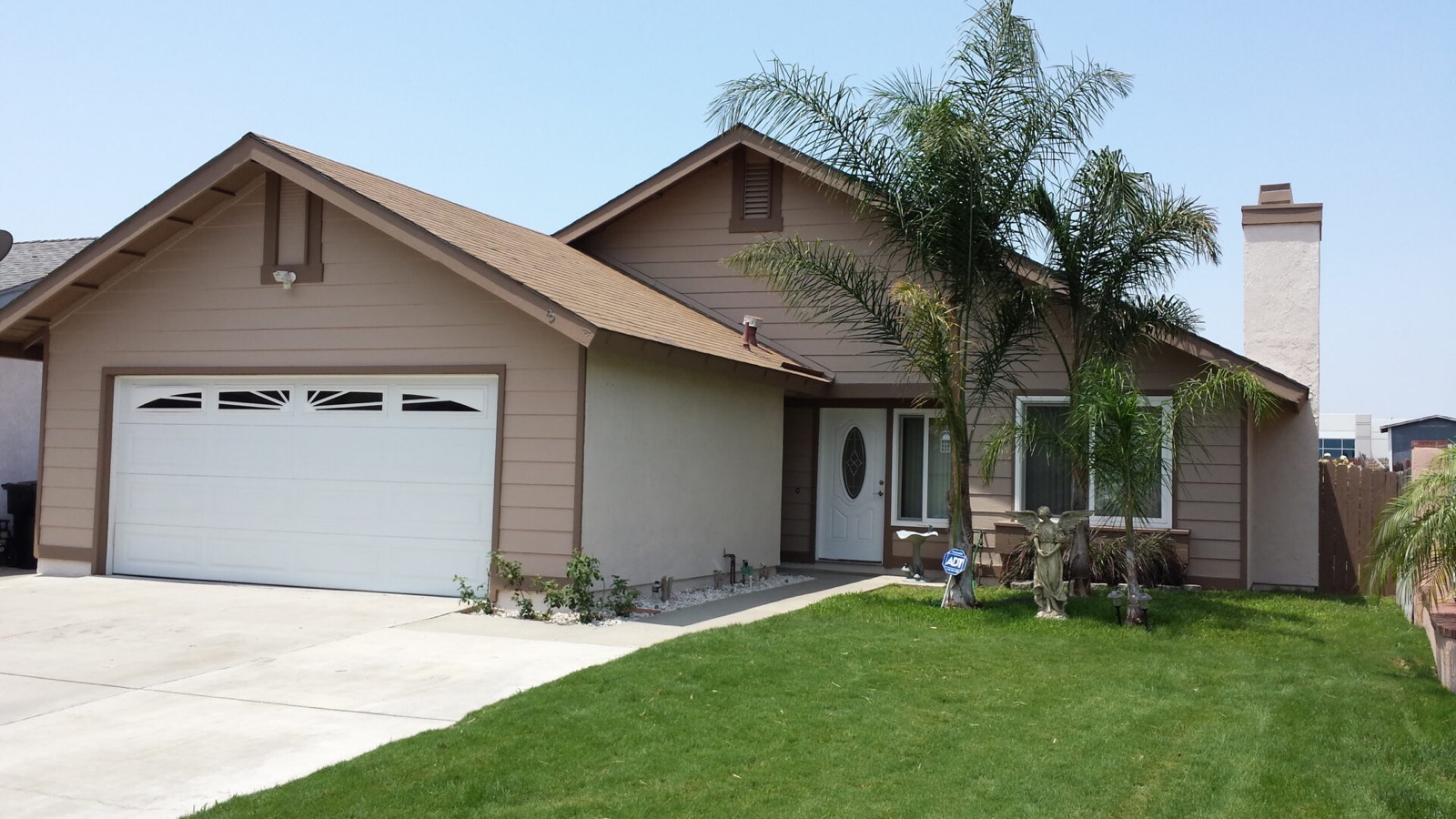
Washing is the first coat of your paint job
We sell washing as prep, because that is what it is. Paint sticks to a wall, not to the chalk and dust on top of it. Every exterior we quote gets washed at the right pressure for the material and then dried to a number before a drop of finish goes on. Before and after shots are in the gallery. Ask for a ballpark whenever you are ready.
☎ (951) 685-1595What is actually sitting on a Riverside wall
Walk up to a sun-facing wall on an older repaint and drag a finger across it. If it comes away dusty with the color of the house on it, that is chalking: the binder in the old paint has broken down under years of ultraviolet exposure and released its pigment as a loose powder. It is the most common thing we take off a wall here, and it is invisible until you touch it.
Underneath and alongside that, this valley adds its own layers. Fine airborne dust settles on everything and never fully quits, especially on horizontal ledges and under eaves. Sprinkler overspray leaves hard-water mineral deposits on the lower few feet of walls and on block, sometimes as a white haze and sometimes as a crust you can feel. Spider webbing and nests collect in every soffit and corner. On homes near the arterials there is a greasy exhaust film that plain water will not touch.
None of that is cosmetic when you are about to paint. Every one of those layers sits between the wall and the finish you are paying for.
Why paint over an unwashed wall lets go
The bond line is the whole game
Paint adheres to whatever it touches first. Put a coat over chalk and the paint bonds beautifully to a layer of loose powder, and that powder is bonded to nothing. The finish can look perfect for a year while the failure is already built in at a level you cannot see. When it goes, it goes in sheets, and it takes the old coating with it.
Dust is a release agent
Fine dust does the same job in a smaller way. It reduces the contact area between the coating and the substrate, so you get a weaker bond overall and early failure at the edges and the high-wear spots. This is the quiet reason a repaint that looked fine at the walkthrough starts showing problems in its third summer.
Growth and grease come back through
Biological growth that gets painted over does not die; it keeps living under the film and pushes back through. Exhaust film and grease are worse, because they actively repel a waterborne coating and cause fisheyeing and crawling as it is being applied. Neither is fixed by more paint.
Mineral deposits break the seal
Hard-water crusting from sprinkler overspray is a hard, non-porous layer with no grip. Painted over, it becomes a patch of coating that has nothing holding it, and it typically fails as a distinct band along the bottom of the wall exactly where the sprinklers reach.
High pressure against soft wash, and where force does damage
Pressure is a tool with a ceiling on every material, and the ceiling is lower than most people assume. Stucco is the local example that matters most. Hit it with a tight tip at high pressure and you erode the sand finish, blow out the texture in patches, and drive water through hairline cracks into the wall assembly behind it. The damage does not always show on wash day. It shows later, as texture patches that no paint job can hide.
Wood is the other one. Aggressive pressure on siding, fascia, or a rail cap raises the grain and leaves a furred surface. Furred wood then drinks coating unevenly and looks rough no matter how good the paint is, so the repair is sanding, which costs multiples of the wash that caused it. Window glazing, old caulk joints, and light fixtures have their own limits.
A soft wash is the alternative: low pressure carrying detergent chemistry that does the work while dwelling on the surface, then a controlled rinse. It is what we use on stucco, on painted siding, and on anything organic and fragile. Real pressure has its place, mostly on concrete flatwork and block, where a surface cleaner gives an even result without wand stripes. The judgment call is which surface gets which, and that is decided on the walk-through rather than at the trigger.

Dry time is part of the schedule, not a rounding error
A washed wall is a wet wall, and waterborne coatings need the substrate dry before they will form a proper film. Paint applied over trapped moisture blisters, and blistering usually shows up weeks later on the elevation that got the least sun, which is why the cause is so often misdiagnosed as bad paint.
In practice, Riverside is generous about this. Dry warm air and an open exposure will take a washed stucco wall to paint-ready inside a day, sometimes the same afternoon on a hot one. What actually decides it is exposure and material. Shaded north walls, dense block, and anything under heavy landscaping hold water considerably longer. Wood siding is slower than stucco. We build the sequence around that, washing the slow elevations first so they get the longest head start, and we would rather move a paint date than open a wall that is not ready.
The practical upshot for you is that washing and painting are usually not the same day, and any schedule that promises both is either working on a very small area or skipping something. When we sequence a full exterior, the wash is a scheduled stage with its own day, the same way the exterior repaint is.
The stage that gets skipped first
Washing is the easiest line to quietly drop from a bid. It happens before anything visible, the homeowner is rarely watching, and nobody can tell from the finished job whether it was done properly or done with a garden hose in twenty minutes. That is exactly why it disappears from light bids.
If a wash quote seems too cheap to be real, show it to us and we will walk you through what is in it and what got left off.
A wash day is also the best inspection you will get of your own house. The crew has hands and eyes on every square foot of the exterior, and we flag what we find: failing caulk joints, hairline stucco cracks, soft wood at a fascia end, weep screeds packed with dirt. You get told about it whether or not it turns into work for us.
Washing work that runs with this
Most wash calls cover more than one surface. These go on the same mobilization:
- House Washing
- Soft Washing
- Driveway Cleaning
- Patio Cleaning
- Sidewalk Cleaning
- Roof Cleaning
- Gutter Brightening
The rest of the city work
This is one page of what the crew does here. Our Riverside page covers the whole catalog, and these are the jobs washing most often leads into:
Riverside is a short drive from the shop in Jurupa Valley, which is why we can put a wash day and a paint day on the calendar close together without either one getting rushed. Around the Wood Streets, Canyon Crest, Orangecrest, and the Mission Inn district the trucks already run the loop most weeks.
Straight answers about washing
Do I need washing if the house does not look dirty?
Usually yes, if you are painting. The layer that matters most is chalking, which you find by dragging a finger down a sun-facing wall and looking for powder in the color of the house. A wall can read clean from the curb and still be carrying the exact thing that would have made your new paint let go.
Will high pressure hurt my stucco?
It can, badly. Too much pressure on stucco erodes the sand finish, blows out texture in patches, and drives water through hairline cracks into the wall behind. That is why stucco gets a soft wash here: low pressure, detergent chemistry doing the work, then a controlled rinse.
How long between the wash and the paint?
Often a day on open sun-facing stucco, longer on shaded walls, dense block, wood siding, or anything under heavy landscaping. We wash the slow elevations first to give them the head start, and we will move a paint date rather than coat a wall that is still holding water.
Can you get the sprinkler stains off the bottom of my walls?
Usually, though it is chemistry rather than force. Hard-water mineral deposits need the right treatment and sometimes staged applications, and very old buildup on porous block does not always come off completely. We will tell you on sight what is realistically removable before we start.
What about my plants and the runoff?
Landscaping gets pre-wet before anything is applied and rinsed again afterward, and we work top down so cleaner never dries on a finished surface. Detergents go on at labeled dilution. Beds, lawns, and hardscape are treated as part of the job because they are.
Is washing included when you paint the exterior?
Yes. It is step one of every exterior we quote, and it is written into the scope rather than left as a line you might decline. Washing the wall is the difference between paint that bonds to your house and paint that bonds to the dust on your house.
Put a real number on it
Tell us what the exterior is carrying and we will come look at it. The walkthrough happens quickly and a price is given at that appointment. Fifty years on the brush, a hundred across the crew, and one rule that has never bent: we use the manufacturer specified amount of paint on all surfaces.
Get a Ballpark