We get this call two or three times a week, usually from somebody in Riverside or Corona or out toward Eastvale who has been staring at the same oak kitchen since the day they moved in. They want to know whether they should have the cabinets painted or rip the whole thing out and start over. Most contractors will answer that question in whatever direction pays them the most. We have been doing this fifty years and we would rather tell you the truth and lose the job than take your money on work that will not hold up.
So here is the honest version. No sales pitch, no scare tactics about how your kitchen is falling apart. Just what we look at when we walk into a kitchen, and how we decide what we would tell our own family to do.
The First Thing We Check Is the Box, Not the Door
Everybody looks at the doors. The doors are what you see, so that is where the eye goes. When we walk a kitchen, we barely look at the doors for the first few minutes. We open every cabinet and we push on the boxes.
The box is the carcass, the actual structure screwed to the wall and sitting on the floor. If that box is solid, square, and the shelves are not sagging, you have a kitchen worth finishing. Doors and drawer fronts are replaceable parts. You can put brand new doors on a good box and nobody will ever know the difference. But you cannot put a good finish on a box that is coming apart, and you cannot fix a sagging carcass with paint.
Here is what a sound box looks like when we open it up. The sides are plywood or solid wood, not chipboard that has swollen up under the sink. The face frame is tight to the box with no gaps opening at the joints. The shelves are flat, not bowed in the middle from twenty years of dinner plates. The cabinet is plumb against the wall and the doors close where they should without you having to lean on them. When we find that, we tell people the same thing every time: your boxes are fine, spend your money on the finish.
That is the whole argument for cabinet refinishing in a nutshell. When the bones are good, a proper finish gives you almost everything a new kitchen gives you visually, and you keep your kitchen usable the entire time instead of eating takeout on the patio for six weeks.
What Actually Changes When You Replace Instead
We are not going to pretend refinishing does everything. It does not. There are things replacement gives you that no amount of paint will.
Layout is the big one. If your kitchen has a dead corner, or the range is jammed against a wall, or you have wanted an island for fifteen years, paint will not solve any of that. Refinishing keeps every cabinet exactly where it is. The footprint does not move an inch.
Door style is the second one. If you have raised panel doors with a heavy cathedral arch on top and what you actually want is flat slab or a clean shaker, painting them does not change the shape. It changes the color. A painted cathedral door is still a cathedral door. Some people are fine with that once the color is right and the kitchen brightens up. Some people are not, and we would rather hear that during the walkthrough than after the job is done.
Interior storage is the third. Soft close, roll out trays, drawers that go all the way to the back of the cabinet. Some of that can be retrofitted into a good box. Some of it cannot. If your whole complaint about the kitchen is that you cannot reach anything, painting is not the answer to your problem.
So the real question is never just refinish or replace. The real question is what is actually bothering you about the kitchen. If the answer is the color and the wear, we can fix that. If the answer is the layout, we cannot, and we will say so.
What Cabinet Grade Actually Means When We Say It
Everybody in this trade says they do cabinet grade work. Very few of them are describing the same process. Here is what it means when we say it, step by step, because the process is the entire difference between a finish that lasts and one that is peeling off the door edge by next summer.
The doors come off. All of them. Every door, every drawer front, all the hardware. They get labeled as they come down so every piece goes back exactly where it started, because cabinet doors are not interchangeable even when they look identical. A door that was hung on the left stile for twenty years has settled into those hinge screws. We number the back of every door and we keep a map.
Anybody who tells you they will spray your doors while they are hanging on the box is telling you they are going to leave a run on the bottom edge and overspray on your ceiling. Doors get sprayed flat, laid horizontal, so the coating levels out under gravity instead of sagging down the face. That is the only way you get a factory looking film.
Degrease before anything else. A kitchen cabinet is the greasiest surface in a house. Twenty years of cooking oil has soaked into that finish, especially the doors either side of the range and the ones over the stove. If you sand a greasy door, all you have done is grind the grease deeper into the wood. We clean first, hard, with a degreaser that actually cuts it, and then we clean again on the doors nearest the cooktop. Skipping this is the single most common reason a cabinet job fails, and you cannot see the failure coming until the finish starts lifting.
Sand for tooth, not for bare wood. We are not stripping your cabinets back to raw. We are scuffing the existing finish so the primer has something mechanical to grab. Every profile, every inside corner of a raised panel, every bead. That is slow work by hand and it is where corners get cut, because the flats are easy and the details are not. If somebody quotes you a cabinet job that takes two days start to finish, they are not sanding the profiles.
Bonding primer, not wall primer. This is the part that matters most and it is invisible in the finished job. A bonding primer is formulated to stick to a slick, previously finished, factory sealed surface. Regular wall primer is formulated to seal drywall. They are not the same product and they do not perform the same. On old oak we also want the primer to lock down tannin so it does not bleed yellow through a white topcoat six months later. There is a whole category of surface priming work that exists exactly for this reason, and cabinets are the least forgiving surface in the house.
Hard curing enamel on top. Not wall paint. Wall paint stays soft. A cabinet door bangs against a face frame thousands of times a year and a soft coating will print, block, and eventually stick to itself. The topcoat has to cure to a hard film. That means the right product, sprayed in the right conditions, with the right number of coats, sanded lightly between them.
Controlled conditions. Doors get sprayed in a controlled space, not in your driveway with the wind kicking up off the 15. Dust in a wet cabinet finish is permanent. So is a bug. Temperature and humidity control matter because these coatings level and cure on a curve, and Inland Empire summer afternoons will flash the surface off before it has a chance to lay down flat.
The Cure Window Is Real and Nobody Wants to Hear It
This is where we lose people, and we tell them anyway.
Dry and cured are two different things. A cabinet enamel is dry to the touch in a few hours. It is not cured. Curing is a chemical process where the film crosslinks and reaches its final hardness, and depending on the product and the weather it takes weeks, not hours. During that window the finish is fully usable but it has not reached full hardness yet.
What that means practically. When we hang your doors back up, we put small bumpers on so the door face is not resting hard against the face frame while the film is still hardening. We tell you to be gentle with them for a stretch. Do not stack heavy pots against a cabinet side. Do not scrub the doors with anything abrasive. Do not tape anything to them. Wipe spills off instead of letting them sit.
A contractor who tells you the kitchen is bulletproof the day he leaves is either lying or does not know his products. We would rather tell you the truth up front and have you baby it for a few weeks than have you call us in March wondering why there is a mark where the trash can hits the door.
Do that, and a properly done cabinet finish will outlast the countertops. We have gone back to kitchens we finished in Norco and Moreno Valley years later for an unrelated job and the cabinets still look right.
When We Tell People Their Boxes Are Not Worth Painting
We turn cabinet jobs down. Not often, but we do it, and here is what makes us do it.
- Swollen particleboard. If the box under the sink has taken a slow leak and the bottom has puffed up and gone soft, that material is done. Particleboard that has absorbed water does not come back. Primer will not consolidate it. It will keep crumbling under the finish.
- Thermofoil that is already lifting. A lot of nineties and two thousands kitchens have a vinyl film heat wrapped over an MDF core. When that film starts peeling at the corners, usually near the dishwasher or above the range, you cannot paint over it and expect anything. The film keeps releasing underneath. The honest answer is new doors on the existing boxes, which is often a good middle path.
- Racked or out of square boxes. If the cabinet has shifted and the doors are hanging crooked no matter how you adjust the hinges, the box has moved. Paint does not straighten anything.
- Structural sag in the run. Long runs of uppers that have pulled away from the wall, or a sink base that has settled. That is a carpentry and cabinet problem, not a painting problem.
- The customer wants a different door shape. Not a defect, just a mismatch between what refinishing does and what the customer actually wants. We say so during the walkthrough instead of taking the deposit.
The owner left a company years back because they were thinning paint and putting half the material on the wall that the job called for. That is why we are willing to tell somebody their kitchen is not a candidate. Doing right by everybody includes telling you when the work you are asking for is not the work you need. You can see the kitchens we have done in the project gallery, and you will notice we are not showing you anything we had to fight.
How Long It Actually Takes
People ask for a number and then they do not like the number, so let us be plain about it.
A properly done cabinet refinish on an average Riverside County kitchen, say thirty to forty doors and drawer fronts, is not a weekend. Between the removal and labeling, the degreasing, the hand sanding of every profile, the priming, the multiple topcoats with sanding between, the drying time each coat needs before it can be handled, and the reinstall and adjustment, you are looking at the better part of a week to a week and a half of actual working days. Weather stretches it. A big kitchen with a lot of glass doors and detailed profiles stretches it.
Here is the part people like. Your kitchen stays usable almost the whole time. The boxes stay on the wall. The countertops stay put. The sink works, the range works, the fridge works. You are living without cabinet doors for a stretch, which is inconvenient and a little ugly, and that is the whole disruption. Compare that to a replacement where the kitchen is gutted, the counters come off, the plumbing gets disconnected, and you are cooking in the garage for a month or more waiting on cabinet delivery.
For a family in Menifee or Murrieta with kids and jobs and a schedule, that difference is often the deciding factor before anybody even talks about the work itself.
Two Tone Kitchens and What We Are Actually Seeing
The two tone kitchen has been running strong out here for several years and it has not slowed down. What it means: uppers in one color, lowers and the island in another. Usually a lighter upper and a heavier, darker base.
The reason it works so well in Inland Empire houses is the ceiling height. A lot of the tract homes built through Eastvale, Corona, and the newer parts of Menifee have eight or nine foot ceilings with uppers that stop well short of the top. A light upper opens that wall up and keeps the room from feeling low. A deep base color grounds the run and hides the scuffs where feet and chairs and dogs hit the toe kick.
Some combinations we have been putting in a lot lately, and why:
- Warm white upper over a deep navy base. Reads clean without going cold. Navy is forgiving on the lowers where the abuse happens.
- Soft greige upper over a charcoal base. Good in a kitchen with a lot of stainless, because the gray family echoes the appliances instead of fighting them.
- Painted uppers with a stained wood island or base. This is where cabinet staining earns its keep. If your island is a nicer wood than the perimeter cabinets, staining it instead of painting keeps that grain visible and makes the island the center of the room.
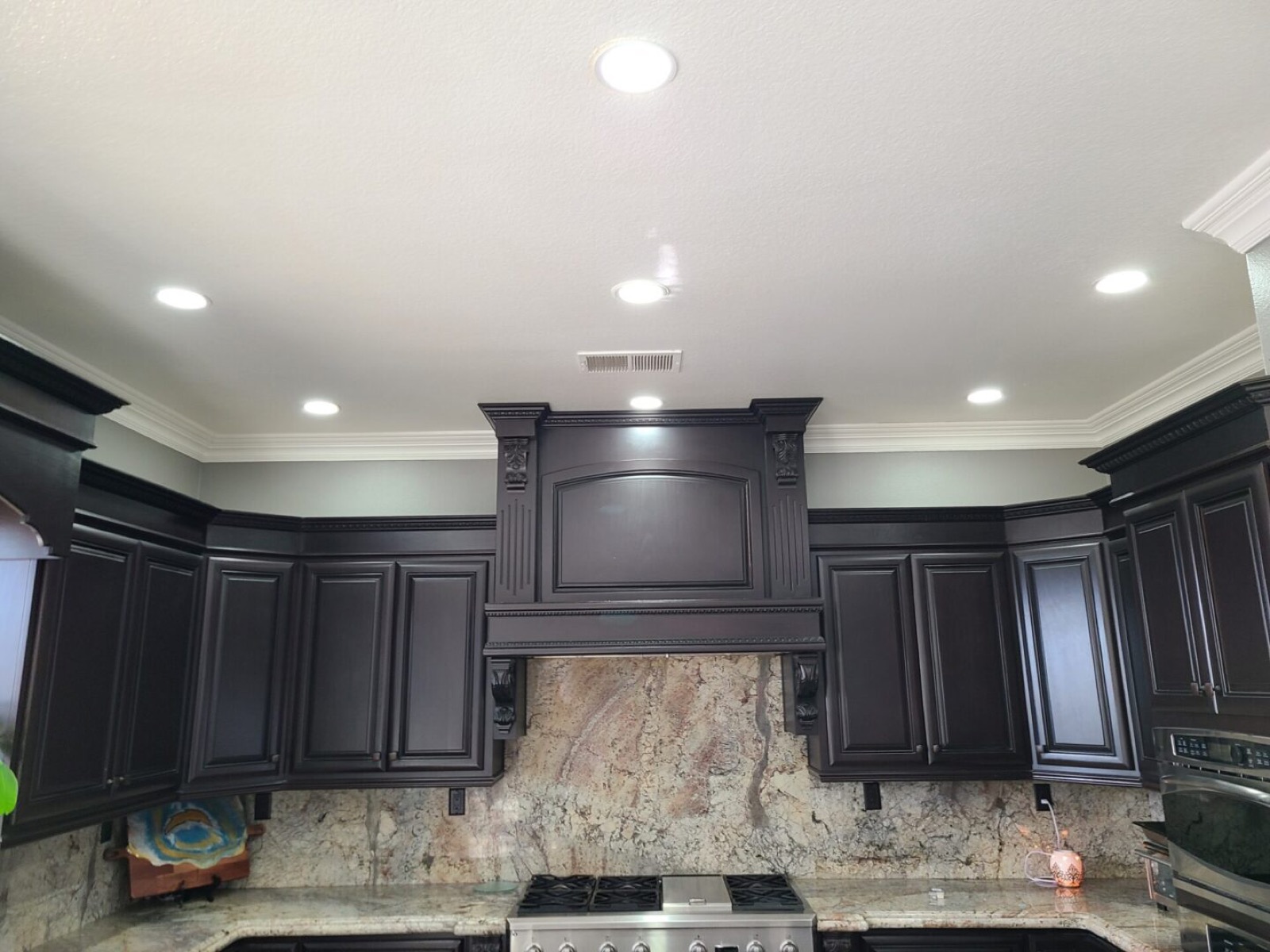
- Espresso or near black on everything with light counters. Bold, and it does not suit every house, but in a kitchen with good natural light it looks expensive.
One practical warning on the dark colors. A deep base color shows dust and fingerprints more than a mid tone does, especially in a satin sheen. That is not a defect, it is physics. We tell people that before they pick, not after. If you have small kids putting hands on the lowers every day, we will steer you toward something a shade or two off the deepest option.
Color choice is the part where people freeze up, and it is worth walking your actual kitchen at different times of day before committing. The light coming into a west facing kitchen in Corona at four in the afternoon is not the same light that is in there at nine in the morning, and a color that looked perfect on the chip at the paint store can go green or pink on you once it is on thirty doors.
What About Just Doing the Island, or Just the Uppers
People ask this and the answer is yes, sometimes it is the smart move.
If your kitchen is mostly fine and it is the island that has taken the beating, we can do the island alone. If the uppers are sun faded from a big window and the lowers are still good, we can do the uppers and match. This is a real option and it is one of the few places where you get a big visual change without doing the whole room.
The catch is matching. If we are painting only part of the kitchen a new color, matching is easy because everything new is one color. If we are trying to match an existing finish on the cabinets we are not touching, that is harder and we will tell you honestly whether it is going to look intentional or look patched. A color match under one light can drift under another. We would rather do the whole run than hand you something that reads as a repair. If you are not sure which way your kitchen falls, send us a couple of photos and we will tell you before we drive out.
Bathroom vanities are the same conversation on a smaller scale, and they are often the best first job for somebody who wants to see our work before committing the kitchen. A vanity is a handful of doors, it is quick, and it lets you live with the finish for a while.
How We Quote It, and What Goes On the Paper
When we walk your kitchen we count doors, we count drawer fronts, we count the exposed box sides, and we measure the face frame. We look inside every cabinet. We check the hinges. We ask what is bothering you about the kitchen, because that answer changes the recommendation more than anything we find with our own eyes.
Then we write it down, and the material goes on the paper by product name. We do that on every job because of how the owner came up in this trade. He spent years at a company that would spec one amount of paint and put half of it on the job, and pocket the rest. He could not square that with himself, so he left and started this company on the rule that we do right by everybody. We use the manufacturer specified amount of paint on all surfaces.
You will not find a price in this article, because a kitchen is not a catalog item. Thirty doors of flat slab in good shape is a different job than thirty doors of detailed raised panel with grease baked into the profiles, and quoting either one sight unseen would be guessing. We come look at it. That part is free and it does not obligate you to anything.
The Short Version
Refinish when the boxes are sound, the layout works, and what you want is a different color and a fresh, hard finish. You will keep your kitchen usable, you will be done in a fraction of the time, and if the process is done right you will get a finish that holds up for years.
Replace when the boxes are failing, when the layout is the actual problem, or when you want a door shape that paint cannot give you. We will tell you that when we see it, and we are not going to try to talk you into paint on a kitchen that needs a cabinet maker.
Somewhere in the middle there is a third answer that gets overlooked: new doors on good boxes, finished properly. That is a real option for thermofoil kitchens and for people who want a different door profile without the demolition. If your kitchen is a candidate for that, we will say so.
If you are somewhere in Riverside County or over in San Bernardino County and you have been going back and forth on this, have us come walk it. We will open the cabinets, push on the boxes, tell you what we would do if it were our own house, and put a ballpark together with the material count on it. Call us at (951) 685-1595 or send us a note through the contact page and we will get out there. Ask about kitchen cabinet painting and we will bring finish samples so you can see the sheens against your own counters. No charge for the visit and no pressure after it, because if we cannot do it right we would rather tell you than take the job.