We have painted houses in this valley for fifty years, and the single thing that delays an exterior job the most is not weather. It is not material backorder. It is a homeowners association architectural committee sitting on a submittal because somebody wrote a color name on a form instead of a color code.
If you live in Murrieta, Menifee, Eastvale, Chino Hills, or the newer tracts up in Rancho Cucamonga, there is a good chance your deed says you cannot repaint the outside of your own house without somebody signing off first. Homeowners hear that and assume it is a formality. It is not. Committees turn people down every month, and most of those denials were avoidable.
Here is how those boards actually work, what they look at, and how we put a package together so you get an approval letter instead of a request for more information.
Why the Board Exists and What That Means for You
Architectural review is written into the governing documents of almost every master planned community built out here since the eighties. The stated purpose is keeping property values steady by keeping the streetscape consistent. Whether you agree with that or not, the committee has real authority, and in California your association generally has to respond to a written architectural application within a set window and give you reasons in writing if they say no.
That last part matters more than people realize. A denial has to come with a reason. So a submittal that answers every likely objection up front is very hard to turn down. That is the whole strategy. We are not trying to charm anybody. We are trying to hand them a package where there is nothing left to ask about.
The people on these committees are usually your neighbors. They are volunteers with day jobs, they meet once or twice a month, and they are reading a stack of applications. A clean submittal that takes two minutes to understand gets approved. A vague one gets tabled until next meeting, and next meeting might be four weeks out. That is where the lost month comes from. Not from a rejection. From a delay.
What Committees Actually Check
After decades of doing this in these communities, the review comes down to a short list. Almost every denial we have seen traces back to one of these.
- Whether your color is on the approved palette. Most associations out here publish a pre-approved scheme book. Sometimes it is fifteen schemes, sometimes it is sixty. If you pick from the book, review is usually fast. If you go outside the book you can still win, but you need to make a case.
- Light reflectance value. LRV is a number from zero to one hundred that says how much light a color bounces back. Plenty of associations set a range, commonly somewhere in the thirties to sixties for the body of the house. They do this to stop somebody painting a charcoal house between two tans. The LRV is printed on the back of the manufacturer chip, and most committees want to see it written on the form.
- The body, trim, and accent relationship. Boards look at your three colors together, not one at a time. Body is the field of stucco. Trim is fascia, eaves, window surrounds, garage door surround. Accent is usually the front door and sometimes shutters. They want the trim to read clearly against the body and they want the accent to stay small.
- Sheen. A lot of documents cap exterior sheen at flat or low sheen on the stucco body, then allow satin or semigloss on trim and doors. Glossy stucco reads cheap from the street and shows every trowel imperfection, so honestly the rule is doing you a favor.
- Adjacency. This one surprises people. Several communities out here will not let you paint the same scheme as the house next door or directly across. So a scheme that is legal on paper still gets denied because your neighbor already claimed it.
None of that is mysterious once somebody tells you. The problem is that nobody tells you. The documents are a hundred and forty pages and the color rules are usually on page ninety one.
How We Build a Submittal That Passes the First Time
We do the paperwork with the homeowner. Not for them, with them, because they have to sign it and it is their house. But we bring the pieces that committees ask for, and we bring them the first time.
Manufacturer names and codes, never nicknames. “Warm greige” means nothing on a form. A committee cannot approve a feeling. We write the manufacturer, the exact color name, and the code, plus the LRV, for the body, the trim, and the accent. Three lines, no ambiguity. If your association keeps a scheme book, we cite the scheme number too. Our paint color matching work matters here, because a lot of owners want the color they already love from a fan deck that the association does not carry, and we can find the equivalent in an approved line.
Large physical samples. A one inch chip stapled to a form is the fastest way to get tabled. We brush out real samples on boards, big ones, using the actual product going on the house. Committees can pass those around at a meeting and hold them against the stucco. This also protects the homeowner, because color changes character at scale and in Inland Empire sun. A beige that looks calm on a chip can read pink at two in the afternoon on a west elevation. Better to find that out on a sample board than on eighteen hundred square feet of wall.
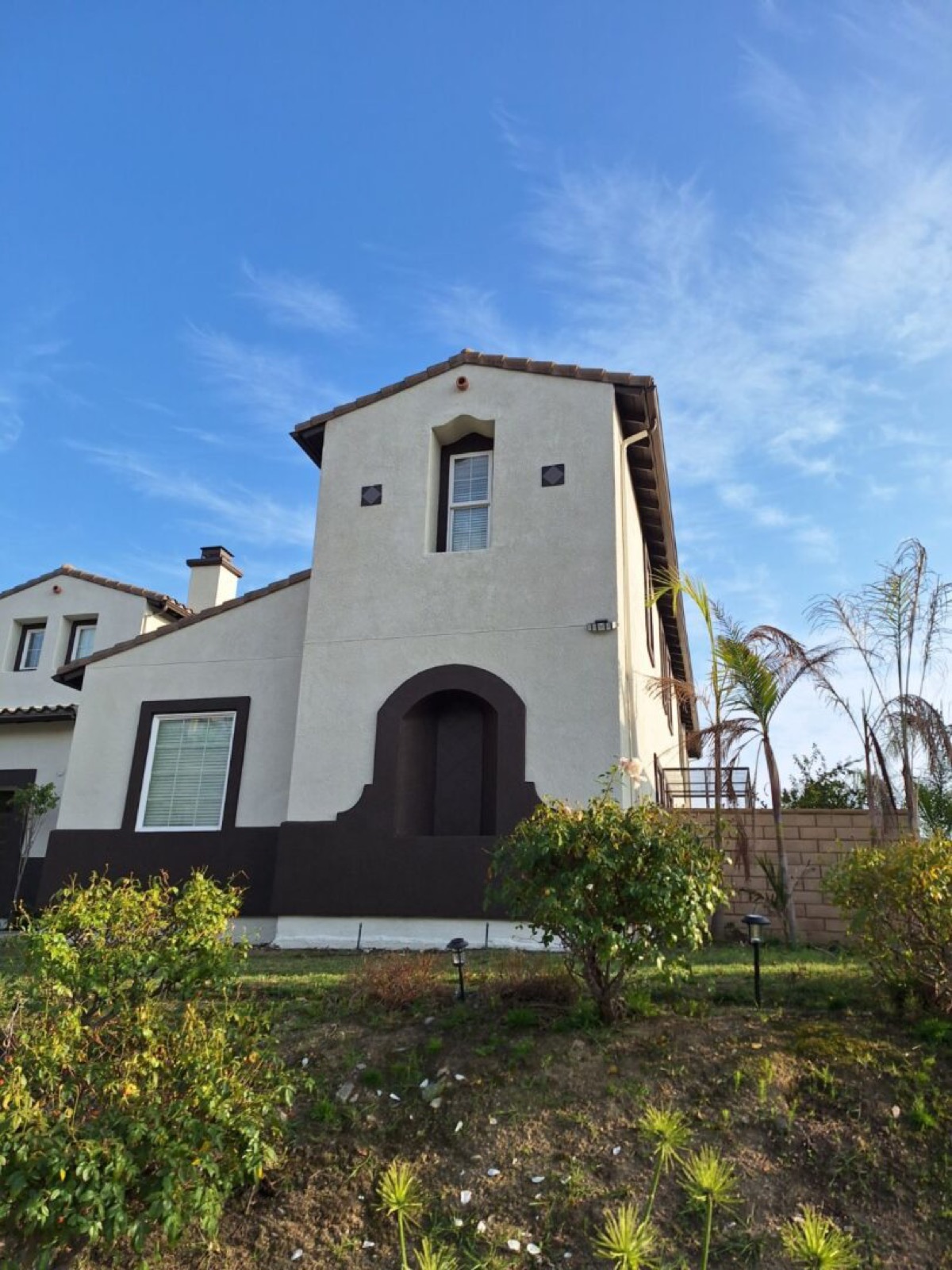
Photos of the house as it stands. Front elevation, both sides, and a close shot of the trim details. Committees want to see what they are changing.
Photos of approved neighbors. This is the piece most people skip and it is the strongest one. If you are proposing something the board might consider a stretch, walk the tract and photograph two or three houses already wearing something in the same family. It is very hard for a committee to deny a color they already approved down the street. We do this walk with clients regularly and it has turned around more than one borderline scheme.
A simple written note on sheen and coverage. One short paragraph saying the body gets low sheen exterior acrylic, trim gets satin, applied at the manufacturer specified amount over primed and repaired substrate. It signals that a real contractor is doing the work, which quietly makes a committee more comfortable.
Timelines, and Painting Around the Approval Window
Let us talk about the calendar honestly, because this is where expectations get broken.
Most associations meet monthly. Some meet twice a month in the bigger communities. Your application has to be in before the agenda closes, which is often a week ahead of the meeting. So if you submit on the wrong Tuesday, you did not lose a week, you lost five. Then the decision letter takes a few days to reach you.
Realistically, from the day we sit down with a homeowner to the day there is an approval letter in hand, plan on three to six weeks in most Inland Empire communities. It can be faster if you are picking from the approved book and the committee handles those administratively, and some do. It can be slower over the holidays when meetings get canceled.
Here is what we do with that window instead of wasting it. Approval governs color. It does not govern preparation. So while the application sits, we can do the work that nobody has to sign off on.
- Wash the house down and let the stucco dry properly, which in itself takes days, not hours.
- Repair stucco cracks, patch, and let those patches cure. Fresh patch material is alkaline and needs time before it takes paint. Rushing this is exactly the corner cutting we refuse to do.
- Replace rotted fascia or trim boards and prime the bare wood.
- Re-caulk windows and door surrounds.
Done that way, the day approval lands, we are pulling out finish material instead of starting from zero. We have handed people a finished house a week after the letter arrived because the prep was already behind us. That work is the same regardless of which of your two finalist colors wins, so nothing is wasted. It is the core of how we approach any exterior house painting job, and it matters double on stucco painting, where the surface has to be sound and dry before a drop of finish goes on.
What Happens When Somebody Paints First and Asks Later
We get this call a few times a year. Usually it is a homeowner who did the job themselves or hired somebody off an app, and now there is a letter from the association on the kitchen counter.
The polite version of that letter asks you to submit an application after the fact. Committees sometimes ratify what is already on the wall, especially if it is close to something approved. That is the good outcome.
The bad outcome is a notice to correct. That means repainting the house in a compliant color at your own cost, on their timeline. Associations out here can also assess fines while the violation stands, and in California an association generally has to give you notice and a chance to be heard before it fines you, but that process still ends with you holding a brush again. We have repainted houses that were eleven months old. Twice the material, twice the labor, and the homeowner paid for both.
There is a quieter version of this problem too. Some folks assume that because they are only doing the trim, or only the front door, no application is needed. Read your documents. Plenty of communities require review for any exterior color change, including a door. A door is a cheap application to file and an expensive one to redo.
If you are already in that situation, call us before you do anything else at (951) 685-1595. Sometimes the fix is smaller than people fear, especially if the existing color is close to an approved one and we can shift it rather than start over.
Choosing Colors You Will Still Like in Year Eight
Approval is the hurdle everybody focuses on. Living with the result is the part that lasts.
Exterior color out here takes a beating that coastal houses never see. Full sun, long summers, and reflected heat off concrete and block wall. Deep saturated colors, particularly reds and some blues, fade faster because the pigments that make them are less stable in ultraviolet light. That is chemistry, not brand loyalty. If you want a strong color on a south or west elevation, we will tell you plainly what it is going to look like in year six, and often steer the strong color to a front door or shutters where it is cheap to refresh.
The other thing worth saying: darker body colors absorb more heat. On a stucco wall in Perris or Hemet in August, that is a real difference in how much heat pushes into the house. Some associations set their LRV floor partly for that reason. When a board tells you no on a very dark body, they are sometimes protecting your air conditioning bill without saying so.
We walk this with clients as part of a color consultation, standing at the curb, looking at the roof tile and the stone veneer and the block wall, because those are fixed. The roof is not changing. The color has to live with the roof. Homeowners who pick from a screen and skip that step are the ones who repaint in three years. If you want to think it through before committing, our paint consultation is the place to start, and you can see how finished schemes actually landed on real houses in our gallery.
The Short Version, and the Part No Committee Inspects
Submit before you buy material. Use manufacturer codes and LRV numbers, never color nicknames. Bring big brushed samples, not chips. Photograph the neighbors who already got approved. Expect three to six weeks and use that time for prep instead of waiting. And do not paint first and ask later, because that letter is expensive.
Then there is the half of this that no board ever looks at. Committees approve a color. What they cannot inspect is film thickness. The association protects the neighborhood look, and it is on your contractor to protect the actual life of the paint job. A properly applied two coat exterior in this climate should give you a long stretch of good looking wall. A stretched one starts failing before the approval letter is out of the junk drawer.
Fifty years ago I worked for outfits that would thin the paint and put on one coat where the job called for two. Nobody sees it the day the ladders come down. Everybody sees it in year three when the color goes chalky and the south wall looks nothing like the north wall. That is why I went into business for myself, and it is why we use the manufacturer specified amount of paint on all surfaces. The idea is simple. A house takes what it takes. If the coverage rate calls for a certain film thickness and the walls got less, somebody stretched it.
We handle this paperwork alongside homeowners in Murrieta, Menifee, Eastvale, Chino Hills, Rancho Cucamonga, Corona, and the rest of the valley every month. We know which communities move fast and which ones need the neighbor photos. If you are staring at a scheme book and a form and are not sure where to start, reach out and we will sit down at the curb with you.
Want to know what the job runs before you file anything? Call (951) 685-1595 or send us a note and we will come walk the house and give you a free ballpark, no obligation and no pressure. We would rather tell you the truth about your house than sell you a paint job.