November 2026
In most bathrooms the paint gives out in one spot before anywhere else. A blister appears on the ceiling right over the tub, or a thin strip starts curling where the wall meets the tile surround, and from there it slowly spreads. The rest of the room can look fine for years while that one corner gets a little worse every month.
It is rarely bad luck. The area around a shower takes more water than any other painted surface in the house, so every weakness in how the room was painted shows up there first. Once you know which weakness it is, the fix is usually plain.
Steam Rises, Then Turns Back Into Water
A hot shower fills a small bathroom with vapor in a few minutes. Warm air climbs, so that vapor gathers at the ceiling and along the top of the walls, and when it touches a cooler surface it condenses back into water. In a busy household the ceiling over the tub can be damp every single day.
Paint is a thin film, and water that sits on it day after day slowly works in. It softens the film, slips behind it at any hairline crack, and the paint begins to bubble. A blister on a bathroom ceiling is usually water trapped between the paint and the drywall behind it.
Lake Elsinore adds a wrinkle of its own. Homes here sit between lake moisture and inland heat, and the older houses near the lakefront are known for damp-side peeling that only proper priming stops. A bathroom on the damp side of one of those homes starts the fight already behind.
The worst spots are the corners and the band right above the tile, where vapor lingers longest and the air barely moves. Look there first when you are deciding whether a bathroom is due. Bubbles, a soft spot that dents under a fingernail, or gray specks gathering in a corner all mean the paint is already losing.
The Exhaust Fan Does More Than the Paint Can
A working exhaust fan is the cheapest paint protection a bathroom can have. A fan that really pulls air clears steam before it has time to settle on the ceiling. A fan clogged with lint, too small for the room, or ducted somewhere it cannot exhaust does very little at all.
You can test yours with one square of toilet paper held up to the grille while it runs. If the fan holds the paper against the cover, it is pulling. If the paper drops, the fan is mostly making noise. Plenty of fans also get switched off the moment someone walks out, while the room is still thick with vapor.
We look at the fan on every bathroom walk-through and tell you honestly what we see. Vacuuming the grille is a job you can do yourself. A fan that will not move air needs repair or replacement by the right trade, and it is worth handling before the repaint. New paint in a room that still traps steam will fail in the same corner again, and that is money spent twice.
The habit that helps most costs nothing. Run the fan through the whole shower and leave it going for a good while afterward, with the door cracked so drier air can get in.
Satin or Semi-Gloss Beside the Tub
Flat paint is lovely on a living room wall and a poor choice near a shower. Its surface is porous at a tiny scale, so it soaks up moisture and holds onto soap film and mildew spores. It also cannot be scrubbed without leaving shiny patches behind.
Bathrooms do far better in a satin or semi-gloss made for high-moisture rooms. The tighter film sheds water, wipes clean and resists mildew much better. Satin keeps a softer look on the walls, while semi-gloss is tougher yet and is usually the pick for the door, the casing and the baseboard in a bath.
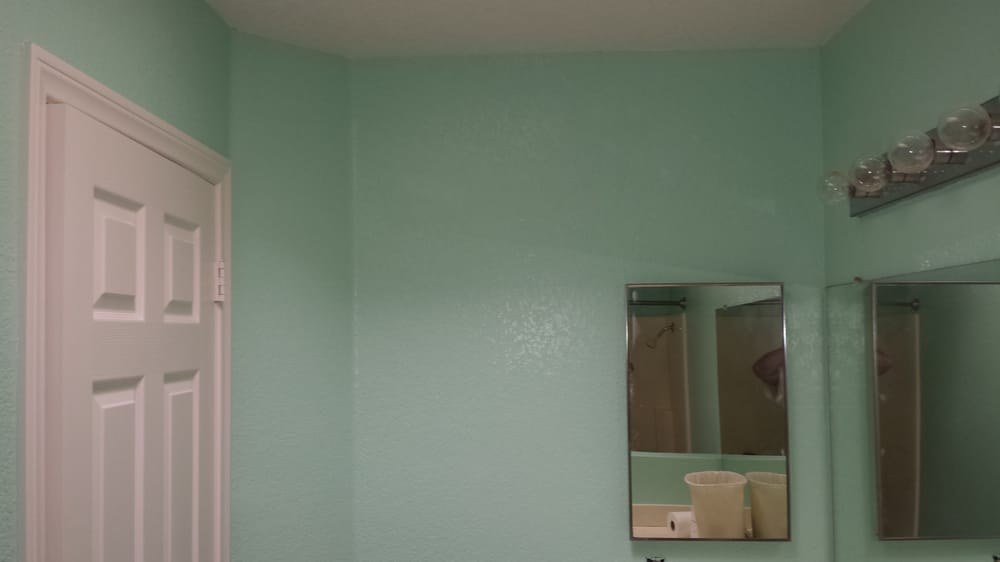
Textured walls, like the mint ones in the photo above, hide small dings well, but every little bump is one more ledge for moisture to rest on. That makes the right sheen matter even more. Many bathrooms also carry a flat white ceiling, which looks clean and is the first surface steam goes after. Over a tub with weak ventilation we lean toward a ceiling paint rated for moisture.
The thickness of the film counts as much as the sheen. A watered-down coat has thin spots where water gets through, and in a bathroom those thin spots peel first. John went into business for himself after watching a former employer use half the paint a job called for. In a room this wet, that kind of shortcut shows up within a season or two.
Mildew, Soap Film and Water Stains Come Off First
Painting over mildew does not get rid of it. The spots grow back through the new coat because the mold underneath is still alive and the moisture that feeds it is still there.
Prep in a bathroom therefore starts with washing. Mildew is treated with a mildew wash and rinsed, soap film and body oils come off the walls around the tub and sink, and the room dries completely before anything else happens. Hairspray and lotion residue near the vanity is easy to miss and behaves the same way soap film does: paint ends up stuck to the residue instead of the wall.
Water stains are sealed with a stain-blocking primer, since ordinary wall paint lets a brown ring bleed right back through. Peeling paint is scraped back to a sound edge and sanded smooth so the old patch does not show as a ridge under the new color.
Bare drywall from a repair, or a spot where peeling took the paint down to the paper, gets primer before any color as well. Drywall paper drinks water fast, and an unprimed patch beside a shower turns soft and lifts long before the wall around it shows a single mark.
A small room hides a lot of brush work. Around the mirrors, the light bar, the door casing and the medicine cabinets, cutting in takes longer than rolling the walls. Cover plates come off and fixtures get masked rather than painted around freehand. On a bathroom repaint, this prep is most of the hours, and it is what decides whether the new color holds.
The Caulk Line Along the Tile Surround
The joint where a painted wall meets the tile surround is the other place peeling loves to start. Water runs down the tile, sits along that edge, and finds any gap between the caulk and the wall. Once it gets behind the paint there, the paint lifts in a long strip.
Caulk that has cracked, yellowed or pulled loose gets cut out completely. The joint is cleaned and dried, and fresh caulk rated for wet areas goes in. The wall color then meets that new bead in a clean line along the top of the tile, with no paint smeared down onto the grout.
That edge is also where people judge the whole job. A wavy line where a mint wall meets white tile shows from the doorway every time you walk in, so we cut it by hand and take our time.
Our bathroom painting in Lake Elsinore handles all of it in one visit: the fan check, the wash, primer where it is needed, new caulk and the right sheen for each surface. The paints we use are water based, so the smell stays mild and the room is back in use quickly. If the hall outside the bathroom is scuffed too, hallway painting fits easily into the same trip.
Show Us Where the Ceiling Bubbles
Is there a corner over the tub that blisters every summer? Call John at (951) 685-1595 or tell us about the bathroom online. We will come out to your Lake Elsinore home, usually the same week, check the fan and the caulk with you and give you a ballpark at that same visit.