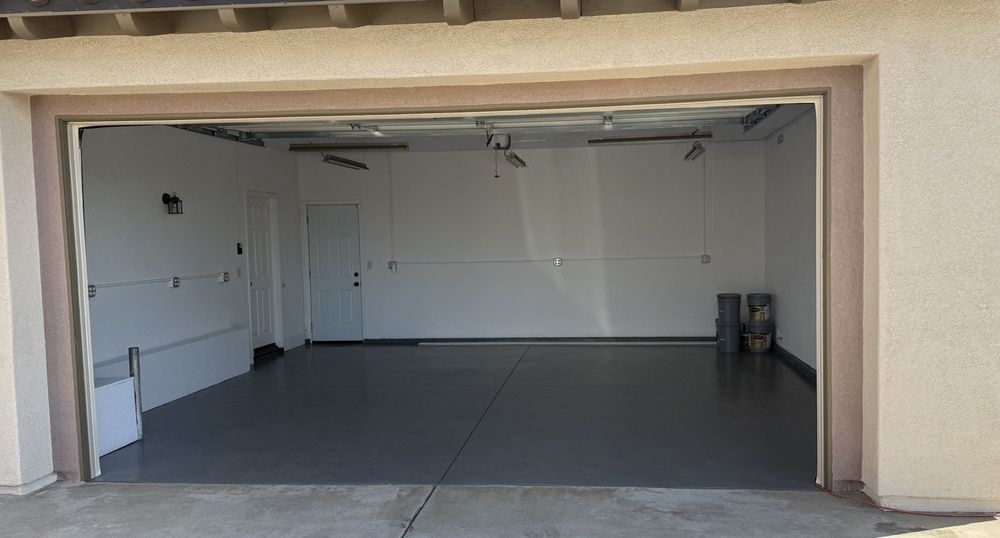
Painted garage floors that hold on when the tires roll in
A garage floor takes a beating no wall in the house ever sees. Hot tires roll onto it, oil drips from the engine, bins get dragged across it, and grit tracks in from the driveway every day. In Lake Elsinore the slab can also push dampness up from the soil, so we check the concrete before we talk colors. Look through finished work in our gallery, then ask John for a ballpark on your garage.
☎ (951) 685-1595Oil, slick concrete and the grip floor paint depends on
Almost every painted garage floor that fails early failed because of what was under it. The color coat gets the attention, but the slab underneath decides how long the job lasts, so most of the hours go into the concrete itself.
Get the oil out of the slab
Paint will not hold over oil, and a slab that has carried a car for years has more of it soaked in than shows on top. We scrub with a degreaser, rinse, and go back over the dark patches until water soaks in instead of beading up. A spot that still sheds water is the spot the paint lets go of first.
Rough up the surface
Troweled concrete is smooth and dense, too slick for paint to bite into. We etch or grind the slab until it feels like fine sandpaper under your palm, then vacuum away every bit of dust, because paint laid on a dusty floor ends up bonded to the dust.
Fill the cracks, leave the joints working
Hairline cracks get cleaned out and filled flush. The straight saw cuts across the floor are control joints, cut on purpose so the slab cracks along them, so we clean them and paint into them instead of packing them with stiff filler that will only split open again.
Roll the coats and wait for the cure
Floor paint goes down at the coverage printed on the label, rolled evenly with the edges brushed tight along the walls and the door line. Then comes the part most households find hardest: the car lives on the driveway until the coating has hardened all the way through.
Lake air on one side of town, inland heat on the other
Lake Elsinore homes sit in an unusual mix: moisture off the lake in some neighborhoods and hard inland heat in nearly all of them. A garage slab gets both. Concrete poured on soil draws water up from below, and a floor that looks bone dry on a summer afternoon can still be breathing dampness through its pores.
Floor paint laid over that damp slab starts losing the fight on day one. Vapor pushing up from underneath lifts the coating in small blisters, then in flakes, often in the middle of the floor where the concrete stays coolest. So we test before we quote. A square of clear plastic taped tight to the slab and left overnight tells us a lot: if the underside fogs or the concrete under it darkens, moisture is coming up, and we talk through what that means for paint before you spend anything.
Some slabs pass easily. Some need a primer made for damp concrete. A few are better left bare for now, and you will hear that from us plainly.
Hot tires, a rushed cure and the patches they pull up
Drive home on a July afternoon and the tires come off the pavement hot and soft. Park them on floor paint that has not finished curing and the rubber grabs the coating, then tears a patch loose when you back out the next morning. The trade calls it hot-tire pickup, and in Lake Elsinore summers it is the usual way a new garage floor gets ruined in its first week.
Dry to the touch comes a lot sooner than ready for tires. Floor paint feels dry under a fingertip fairly soon, then keeps hardening underneath for a good while longer, and tires need the hardened version. For the product on your floor we tell you how long to keep the car out, and parking on the street a little longer beats a callback to patch tire tracks.
Paint spread the way the label says
The thinned-paint habit John watched at his old employer does extra harm on a floor. A stretched coat leaves a thinner film to stand up to tires and dragged trash cans, so it wears through first in the lanes where the car rolls in. We roll floor paint at the label’s coverage rate, which is what keeps those lanes gray instead of bare.
Walls, ceiling and floor done in one trip
Most garages we see have walls that match the floor: scuffed at bumper height, dulled by dust, patched where old shelving came down. Painting the whole room together saves a second visit, and the order of work matters.
Top down, floor last
Ceiling first, walls next, floor at the end, so nothing drips onto a fresh coating. Garage walls get a washable finish, since bikes, bins and swinging car doors will bump them for years.
The door into the house
The house door and any side door get their own enamel along with the casing. The line where the floor paint stops at the wall base and the threshold should be crisp and straight, and we cut it by hand.
An empty garage
A floor job needs the room cleared to the walls. We tell you ahead of time what has to come out and plan the days so the tool chest, the bikes and the boxes have somewhere to wait.
When we would tell you to wait
Doing right by people sometimes means talking them out of a job, or at least out of doing it this month. Brand-new concrete needs time to give up its water before any coating goes on. A slab that failed the plastic test may need a different system altogether. A floor sealed years ago with a clear product has to be stripped or ground, or new paint will slide right off it.
If the rest of the house is on your list, our Lake Elsinore pages for hallway painting and bedroom painting cover the rooms that get scuffed almost as badly, along with bathroom painting for the wettest room in the house and shed painting for the outbuilding out back. Our main garage floor painting page covers the service across our whole route, and the Lake Elsinore page shows everything else we do in town.
Garage floor questions we hear around the lake
How long before I can park on the new floor?
Longer than most people expect. Floor paint is fine to walk on well before it is hard enough for tires, and summer heat makes tires softer and stickier. We give you the timing for the exact product on your slab, and waiting the full stretch is what saves the floor.
Do the oil stains have to come out completely?
As much as cleaning can pull out, yes. We degrease and rinse until water soaks into the stained spots instead of beading on them. A stain so deep it still repels water gets more scrubbing, because paint over leftover oil is the first patch to lift.
What if the slab has moisture coming up through it?
Then a standard floor paint is the wrong answer, and we say so before you spend anything. Depending on how much moisture shows, the fix may be a primer made for damp concrete, a different coating system, or leaving the floor bare and painting the walls.
Can you paint over my old peeling floor paint?
Not over the loose parts. Anything flaking or lifting comes off first, and the edges of the sound paint get feathered so they do not telegraph through. If most of the old coating is failing, removing all of it is usually less work than chasing patches for years.
Will a painted floor be slippery when it gets wet?
Smooth floor paint can be slick with water or oil on it. Where that matters, such as the strip by the house door, we can mix a fine anti-slip grit into the final coat. It gives your shoes some grip and still sweeps clean easily.
Can you paint the garage walls in the same visit?
Yes, and it is usually the smartest way to do it. We paint the ceiling and walls first and the floor last, so nothing drips onto the new coating. Walls get a washable finish that can handle bikes, bins and car doors bumping into them.
Have John look at the slab with you
Tell us how many cars the garage holds, whether the floor has been painted before, and where the oil spots are worst. We come out, look over the concrete, talk through the moisture check and the cure, and you hear a number at that visit, with the written copy the next morning. Prefer to start on the phone? Call (951) 685-1595.
Ask for a garage floor ballpark