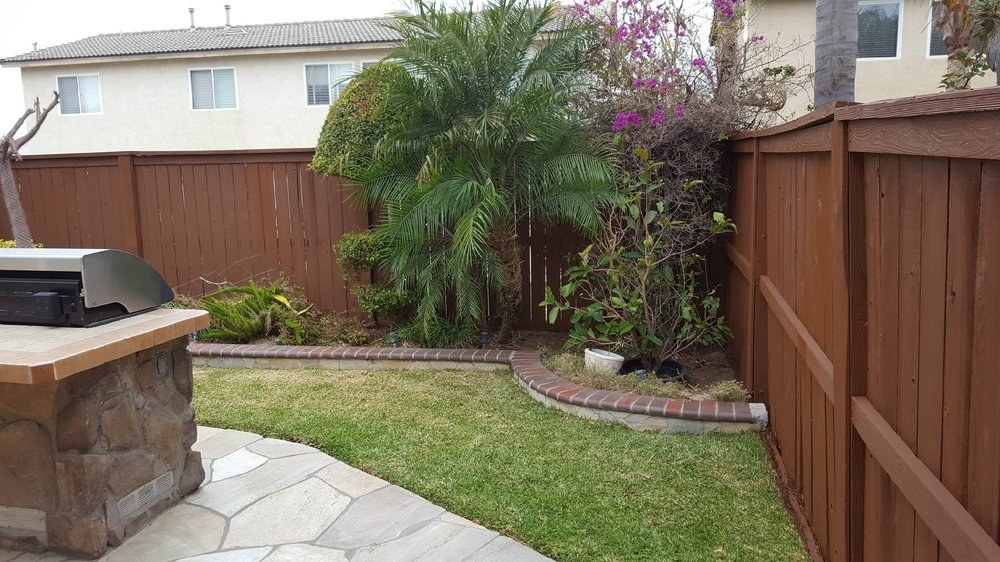
Board fences that soak the stain in instead of shedding it
A wood fence in Perris spends its days in open sun and blowing dust, and it usually shows the wear before the house does. We wash the boards, give them time to dry out properly, then work the stain in at the strength the can calls for, never cut with water to make it reach further. Look over finished jobs in our gallery, then ask us for a ballpark on your fence.
☎ (951) 685-1595Semi-transparent or solid, chosen by the boards you have
A semi-transparent stain tints the wood and leaves the grain showing. On a fence that is still fairly sound, with boards close to each other in color, it gives the warm, natural look most people picture when they say stain. It also shows everything underneath it: old patches, a replaced board, a pale stripe where a sprinkler hit the same spot for years.
A solid stain covers more like paint while still soaking into the wood. On older boards that weathered unevenly, got patched with new lumber, or carry an earlier stain that wore off in some places and not others, solid color is usually the honest choice. It hides the mismatch rather than putting it on display. Our fence staining work weighs that same choice on every fence we take on.
Trying the color on your own boards
Before anyone buys a whole fence worth of product, we like to stain a couple of boards that represent the job, one from the sunniest run and one from a shadier stretch. Seeing the color dry on your own wood settles more questions than any chip card can.
Stain does its work by soaking into the board, so the board has to be clean, dry and open enough to let it in.
From a dusty gray fence to wood that will take stain
Wash the fence down
Every face we plan to stain gets washed to lift the dust, the loose gray fiber and any mildew along the bottom boards. Pressure stays low enough to clean the wood without tearing up the grain. Fences that need a deeper cleaning first fall under our fence cleaning service.
Let the boards dry through
Wet wood will not take stain, so we wait until the boards are dry all the way in, and we check rather than guess. In Perris heat the face of a board dries fast while the inside stays damp, which is exactly what fools a crew in a hurry.
Protect what lives along the fence
Flagstone, block walls, planting beds and the trash bins all get covered or moved before a drop of stain comes out. Stain that lands on porous stone soaks in and stays, so the patio edges get protected ahead of time instead of scrubbed afterward.
Work the stain into the grain
Stain goes on by brush, or sprayed and back-brushed, so it gets pushed into the wood and into the gaps between boards rather than left lying on top. Posts and the cap rail get the same full coat as the long runs of board.
Flatland sun, blowing dust and boards gone gray
Perris sits on open, flat ground, and a backyard fence has nothing to shade it. The sun works on the wood all afternoon through the summer, and the dust that drifts across town settles into the grain. Slowly the surface of each board goes soft and silvery as the outer wood fibers break down. Run a hand over a gray board and you can feel the fuzz.
That loose gray layer is why so many stain jobs fail early. Stain is made to soak into wood, and it cannot soak through dust and dead fiber. It sits in that top layer instead, and the top layer is already coming apart. Whether the fence stands behind a newer stucco house near May Ranch or Villages of Avalon, or beside one of the older wood-sided places downtown, the order of work stays the same: get down to sound wood before anything else.
John went into business for himself after watching an employer put half the paint a job called for on house after house. Fences invite the same shortcut. Stain is thin to begin with, a long run of boards eats a lot of it, and a splash of water makes the buckets go further. We do not thin it. Every board gets the amount the manufacturer specifies for that product.
A watered or stretched coat gives itself away quickly. Some boards drink more than others, so the color goes patchy, darker where the wood got enough and pale where it went hungry. The pale boards gray out first, and a year later the fence can look older than it did before anyone touched it. If the boards have you unsure, book a time and we will look at them with you before anyone talks color.
Sharing a fence with the yard next door
A backyard fence usually has two households looking at it, one on each side, and the job goes smoother when both of them know it is coming.
One face or both
We can stain only your side, and plenty of people choose exactly that. If your neighbor wants the other face done as well, the whole fence weathers at the same pace and the color reads the same from both yards. We price the two faces separately, so each household can see what its own side involves.
A word with the neighbor first
Spray can drift and wet stain can drip through the gaps between boards, so we ask you to tell the neighbor which day we will be there. If their car, their dog or their patio chairs sit right against the fence, moving things together the evening before beats an apology afterward.
Getting to the far side
Staining the outer face means working from the neighbor’s yard, or from whatever strip runs behind the fence. We only go over with permission, and we leave their side as clean as yours. If that face cannot be reached, you hear it from us before the job starts, never halfway through.
Side yards with no room to spare
A side yard is often barely wider than a person, with the house wall on one hand, the fence on the other and the bins lined up between them. The stucco there gets masked along with the walkway, because that narrow stretch is where a brush is most likely to slip.
Work that tends to sit on the same fence line
A tired fence rarely needs only one thing:
More of our Perris pages
Other rooms and surfaces we take on around town:
Fence stain questions from Perris backyards
Should my fence get semi-transparent or solid stain?
It depends on the boards. Sound wood that weathered fairly evenly looks good in a semi-transparent stain that lets the grain show. Older fences with replaced boards, patches or an uneven earlier finish usually look better in solid stain, which evens the color out. We test both on your fence first.
Why does the fence need washing before stain?
Dust and the gray, broken-down fibers on an old board sit between the stain and the sound wood underneath. Stain is meant to soak in, and it cannot get past that layer. It ends up bonded to loose material that keeps wearing away, so the finish fades and grays out early.
How do you know the wood is dry enough?
We check it instead of going by the calendar. A washed fence can feel dry on the face in Perris heat while the inside of each board still holds water. Stain over damp wood soaks in poorly and tends to look blotchy, so we wait until the boards are dry through.
Will you stain my neighbor’s side of the fence too?
If your neighbor agrees, yes. Both faces done together wear at the same pace and match from either yard. We price each face on its own, ask before stepping into anyone else’s yard, and keep their side as tidy as yours. Plenty of people stain only their own face, which is fine.
Why did my last stain job turn blotchy so fast?
Usually the stain was thinned or spread too far, or it went on over dust. Boards that drank more turn darker while the starved ones go pale and gray out first. We use the amount of stain the manufacturer specifies for the product, and only on clean, dry wood.
Can you keep stain off my patio and plants?
Yes. Flagstone, block walls, planting beds and anything stacked along the fence get covered or moved before we start. Stain does not wipe up from porous stone, so it gets protected ahead of time. Bins and pots go back where they belong when the day’s work is done.
Let us walk the fence line with you
Tell us roughly how long the fence runs, whether it has been stained before, and whether the neighbor wants their side done too. We come out, run a hand along the boards, see how far the gray has gone, and talk through semi-transparent against solid with your actual wood in front of us. The price is in your hand by the time that visit ends. Rather start with a phone call? The number is (951) 685-1595.
Get a ballpark for the fence